Second-hand does not work because of awareness, but because of infrastructure.
When I arrived in Denmark six years ago as a student, something didn’t quite add up for me. The students around me, living on a nice but limited budget, could afford Louis Poulsen lamps, Rains coats, Mads Nørgaard items, and Acne Studios bags. Listen, there’s no Primark in Denmark, there are hardly any cheap chains, yet no one showed up to class naked. How did that happen?
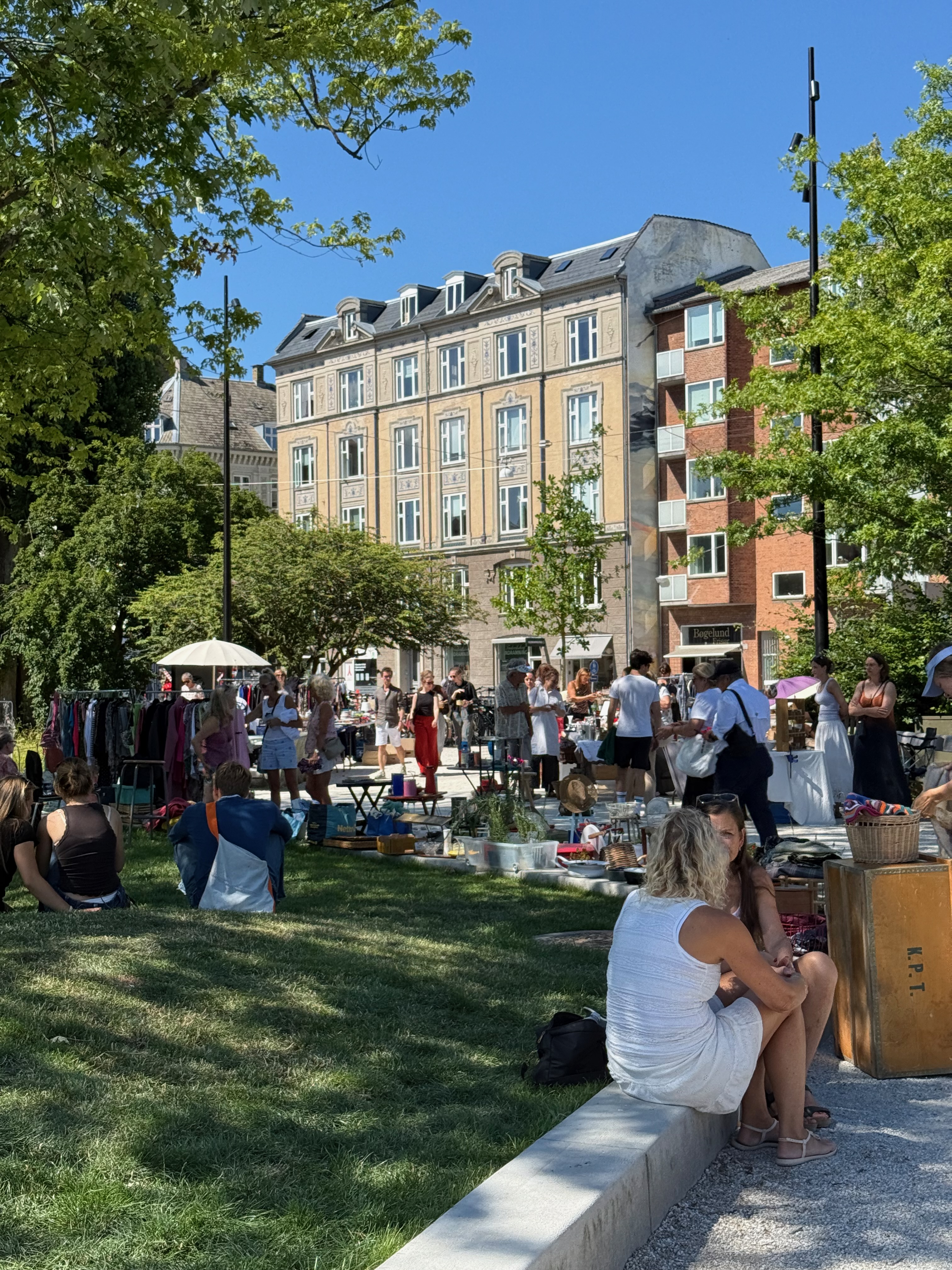
The answer came in the summer. I arrived here at the height of the pandemic, during long months when closed spaces stood empty and the cold left the streets deserted. Copenhagen’s circular economy—a whole culture that requires the tactile experience of fabrics, street interaction, and human closeness—patiently awaited the warm season. Then the sun drew closer to Copenhagen, the open spaces filled up, and for the first time, after nearly a year in Copenhagen, I encountered a local second-hand market.
I couldn’t believe my eyes. High-quality Scandinavian brands, which I had learned to admire over the past year only through shop windows, were suddenly being sold at ridiculous prices and were open to haggling. In a country where design is part of the national identity, objects are seen as things worth repairing, passing on, and living with for years. This circular economy makes high Scandinavian quality accessible even to those living on a limited student budget. Buying second-hand goods in Denmark is a local logic that allows everyone to dress and furnish their homes at the highest level.
In Israel, almost every sector knows how to identify something second-hand that they already believe in. The left will talk about sustainability, recycling, and community. In Arab society, one can identify a strong tradition of passing things on among relatives, repairing, and reusing. In the religious and ultra-Orthodox public, they will speak of acts of kindness and not wasting. The economic and national right will discuss thriftiness, independence, less reliance on imports, and a local economy.
And that’s exactly the point: everyone already understands the value. Each camp holds a different moral language for that basic idea. The problem isn’t that we lack values. We have too many values.
But values don’t easily translate into everyday life. In Israel, the second-hand culture still stumbles between WhatsApp groups, piles of polyester that have taken over every good bench, and initiatives that depend on good women carrying the community on their backs for free.
True, the Danes have a deep environmental awareness. But, as I argue, these values manage to thrive in Danish everyday life and seep into public consciousness because they rely on a foundation that makes them simple, smart, and rewarding consumer behavior.
This enormous gap between the Israeli desire and the Danish reality stems directly from the absence of basic infrastructural conditions that we must implement here as well:
Widespread and easy participation: The act of selling is as simple as buying. Anyone can bring a rack from home and set up a stall for 100 to 300 kroner (about 50–150 shekels). In the summer, markets fill the streets, and in the winter, they migrate to closed spaces, while throughout the year, the culture pulses in apps, cooperatives, and consignment shops. This accessibility turns every consumer into a supplier. Money changes hands quickly, stays within the community, and today’s sale simply funds everyone’s quality purchase for tomorrow.
Flexible urban space: Public space planning here is based on "mixed-use" over time. A square, park, or schoolyard doesn’t freeze in place on the weekend. They are pre-planned with infrastructure that allows them to change faces and easily host swap and second-hand markets. The physical built environment encourages the circular economy simply by being accessible and multifunctional.
Mail! Yes, mail (and for the same reason—bicycles and the metro): just as McDonald's is primarily a real estate empire and only secondarily a burger chain, the second-hand industry is fundamentally based on movement and logistics. The way we move through space is critical to the ability of objects to transfer from one place to another efficiently. The second-hand culture here is developed thanks to this infrastructure—the ability of an individual to send a package exists as easily as collecting a Shein bag from the grocery store in Israel. The transportation infrastructure expands these possibilities even to furniture: the freedom of movement in the space allows people to transport entire pieces of furniture through the metro, and that’s already a local joke. I’ve often seen a couple hauling a dresser into the carriage.
Quality of raw materials. Buying a second-hand item means acquiring an object that has proven to you that it has survived a full life. Giving it away for free is allowing someone to pay taxes on an item that isn’t trendy anymore, or that has already seen better days, all under the guise of moral activity.
And that’s my message:
The real confrontation with consumer culture requires much more than raising awareness or education. The social world doesn’t move solely because of values and good intentions. It moves within structures, infrastructures, and power relations that allow good, or bad, to happen easily.
Values need systems to become everyday.
So instead of asking how to educate people to buy second-hand, maybe it’s time to ask a different question:
What needs to be built so that it simply pays off for them?
Want to deepen your experience in Copenhagen and discover the second-hand shops and local markets for yourself? Write "maps" or "tour" in the comments, and I’ll send you my shop map and an invitation to the next tour.
Newsletter
Stay in the loop
New field notes in English, delivered to your inbox. No spam, unsubscribe any time.